Spent an interesting morning in the company of many Perl mongers at the London Perl Workshop. Although I don’t use Perl as my primary language any more, it was was interesting to learn about the current movements of its London-based community. The talks I attended were:
- The Complete History of the Perle Mongers of Olde London Towne - Dave Cross
- DBIx::Class for (advanced) beginners - Leo Lapworth
- closures for fun and maybe profit - David Cantrell
- Catalyst, DBIx::Class and PostgreSQL - Matt Trout
- Introduction to Moose - Mike Whitaker
In particular, DBIx::Class caught my eye as a nice way of abstracting database details behind more friendly object methods. Although, as the list of contributors shows, this is a highly complex problem to solve and achieving a “one size fits all” solution may be unrealistic.
Matt Trout’s talk was a little disappointing. Although I admired his passion and enthusiasm, there was far too much crammed in the 40 minute talk. Just concentrating on one aspect of the development process would been more useful. However, saying that, he did enough to convince me that I need to revisit PostgreSQL at some point in the future.
My colleague Mike Whitaker talked about the “postmodern object system”, Moose. There was lots of questions by the end of the talk, which was a good sign that the introduction had achieved its aim.
Overall, a good experience and a reminder that the Perl community is very much alive and well.
Prompted by a question posed by one of my colleagues today, “has anyone ever used Lisp?”, I surprisingly found myself being the only person that had.
I played around with it many years ago after being inspired by Eric S. Raymond’s seminal article, “How to Become A Hacker” in which he explained that “getting” Lisp is equalivent to finding programming nirvana.
Whilst I didn’t quite reach those levels, I found that using Lisp was a great learning experience. Despite it being half a century old, it is still a relevant language today; the online Practical Common Lisp book contains examples of a spam filter, an ID3 tag parser and other real-world examples.
The following two links are for the curious who might wish to try it out:
A very simple example of the new BOSS Key Terms API: enter a search query, and see the relevant words and phrases:
Search Key Terms
Some examples:
The London Perl Workshop is a free one-day conference in central London, UK. It will be held on Saturday the 29th of November, 2008 at Westminster University’s New Cavendish Campus
I’ll be attending, and so will my friend and fellow Yahoo Mike Whitaker, who will be presenting some talks on Moose and Enlightened Perl.
The new BrowserPlus framework - a way of extending your browser capabilities - will become open source next year, which seems a sensible way to increase its adoption:
The big idea here is that we’ll have the whole platform open sourced by mid-next year, and as soon as possible we’ll have many of the services we’ve written open sourced, as well as the APIs needed to write new services. Our goal is to empower the community to contribute actual patches and new services - code to compliment the feedback.
Wise words taken from a list of programming epigrams from 1982:
Epigrams on Programming
A good tip from Zend, who recommend omitting the closing PHP tag (?>) when your files contain pure PHP code. This can prevent additional whitespace being inserted into the script output. Extra whitespace can cause problems, for example, if you are trying to set your own custom HTTP headers: nothing should be output before the call to the header function. Otherwise, this classic error will occur:
Cannot modify header information - headers already sent by (output started at myinclude.php:16) in myscript.php on line 15
Zend Framework: Documentation
Are you around London this evening? Fancy learning how to leverage Yahoo’s new BOSS search API?
BOSS - Build (your) Own Search Service is Yahoo’s new API which allows you to build a search engine based on our systems. It is one of the first steps to make Yahoo! much more open for you to enhance and customize our offers for yourself.
During the BOSS hack event you will be able to meet the team, learn all about the API and have a first go at building your own search engine in a matter of minutes.
Check out the Upcoming event page for more information, and to sign up.
Yahoo! BOSS Hack Evening in London at Wallacespace (Monday November 10, 2008) - Upcoming
Wow.
Open source is interesting. Apple has embraced Webkit and we may look at that, but we will continue to build extensions for IE 8.
AppleInsider | Microsoft considers adopting WebKit for Internet Explorer
I love Flickr, and the iPhone has opened up even more possibilities to interact with it. Here are my favourites:
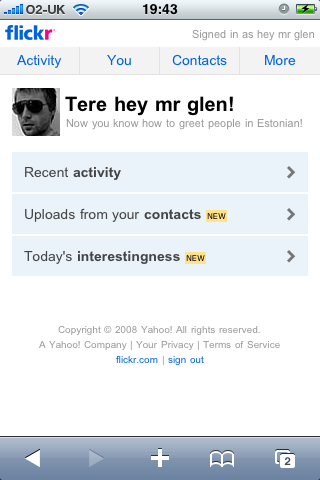
1. Flickr web application

The official iPhone client, and the best. m.flickr.com
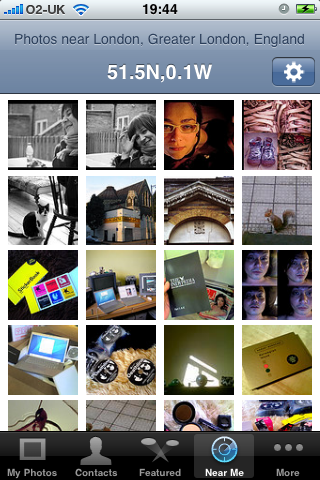
2. Exposure

The Exposure webapp has a great feature called “Close To Me” which, predictably, shows you Flickr photos taken close to your current location. Scarily accurate, even on non-GPS iPhones like mine. Grab it from the iTunes Store: Exposure.
3. CameraBag

A webapp which applies filters to the photos taken with the iPhone’s crappy camera and makes them beautiful. Grab it from the iTunes store: CameraBag.
4. iPhone screenshots
iPhone OS 2.0 introduced the facility to take screen grabs: Simply hold down the home button and press and release the power button on top of the phone. The screen will flash, and a screen grab will be saved in your photos.
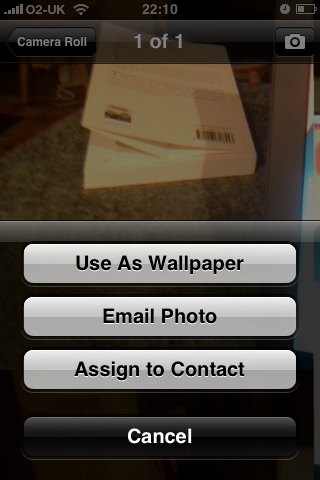
5. Send iPhone camera photos to Flickr

A very simple way of sending your iPhone photos to Flickr is via e-mail: Flickr allows you to set up a dedicated @photos.flickr.com address for your account. Go onto Your Account on Flickr and click the Email tab. Your Flickr upload email is listed on this page. Save this to your address book and use the Email Photo option to send the photo to this address.